
Let’s talk “Collabor-actions”: In the Shadow of Collaboration

Dr. Umuhoza Thérèse
November 1, 2025
For decades “collaboration” has been the darling of global health, the word that looks great in press releases, funds glossy conferences, and fills organizational charts with neat dotted lines. As someone who works at the intersection of health security research and development program, I have seen collaboration perform wonderfully on document as noted for formal agreements, steering committees, and politely worded joint statements that make funders happy and PR teams busier.
It’s polished, it’s professional, and it’s politically safe, the kind of thing you bring to a ministerial meeting and leave unchanged in the final report.
But behind that brightened stage, a different force quietly gets the real work done the “collabor-action”. While collaboration sets the blueprints, collabor-action is the pragmatic craft of getting things done when the blueprints are still drying. It is the gritty, often unrecognized practice of small teams who face an immediate problem and decide to solve it rather than waiting for the next round of approvals. These are the people who discuss cases in a WhatsApp community of specialists before the official data-sharing agreement is final, who solve APIs issue over a weekend because the clinic needs connection, or who co-designed a training manual with community health workers not as beneficiaries, but as equal architects.
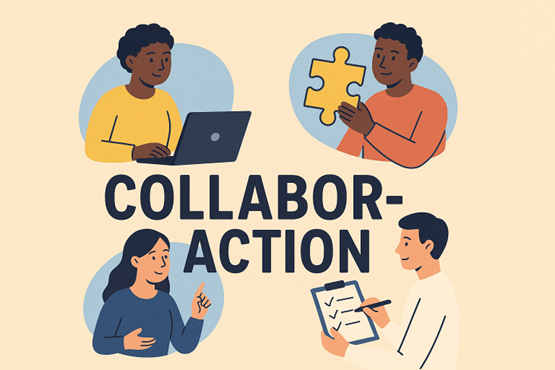
Collaboration convenes, where collabor-action implements.
If collaboration is the public blueprint, collabor-action is the working prototype that proves the blueprint can work in the real world. Collaboration convenes, where collabor-action implements. Collabor-action lives in the shadows because it is often born of necessity, not committee schedules. It’s messy, it’s agile, and yes, it sometimes operates without the full compliment of signatures bureaucracies seem to love. That messiness is a feature, not a bug, it lets grassroot innovators, researchers, practitioners and frontline workers adapt quickly, prototype cheaply, and prove concepts in context. They get things moving long before a policy note appears.
The shift being witnessed in movements and forums like those Pan-African Summit is not the invention of collabor-action. The continent is realizing that the slow, cautious pace of traditional collaboration is a luxury it can no longer afford. The real, durable progress has always been driven by those focused on actionable outcomes, and its finally time to reshape the entire system in that image. For a sustainable health security, we must revalue how partnerships are designed and measured.